We use cookies and analytics to understand how the site is used and to improve your experience. You can accept or decline.
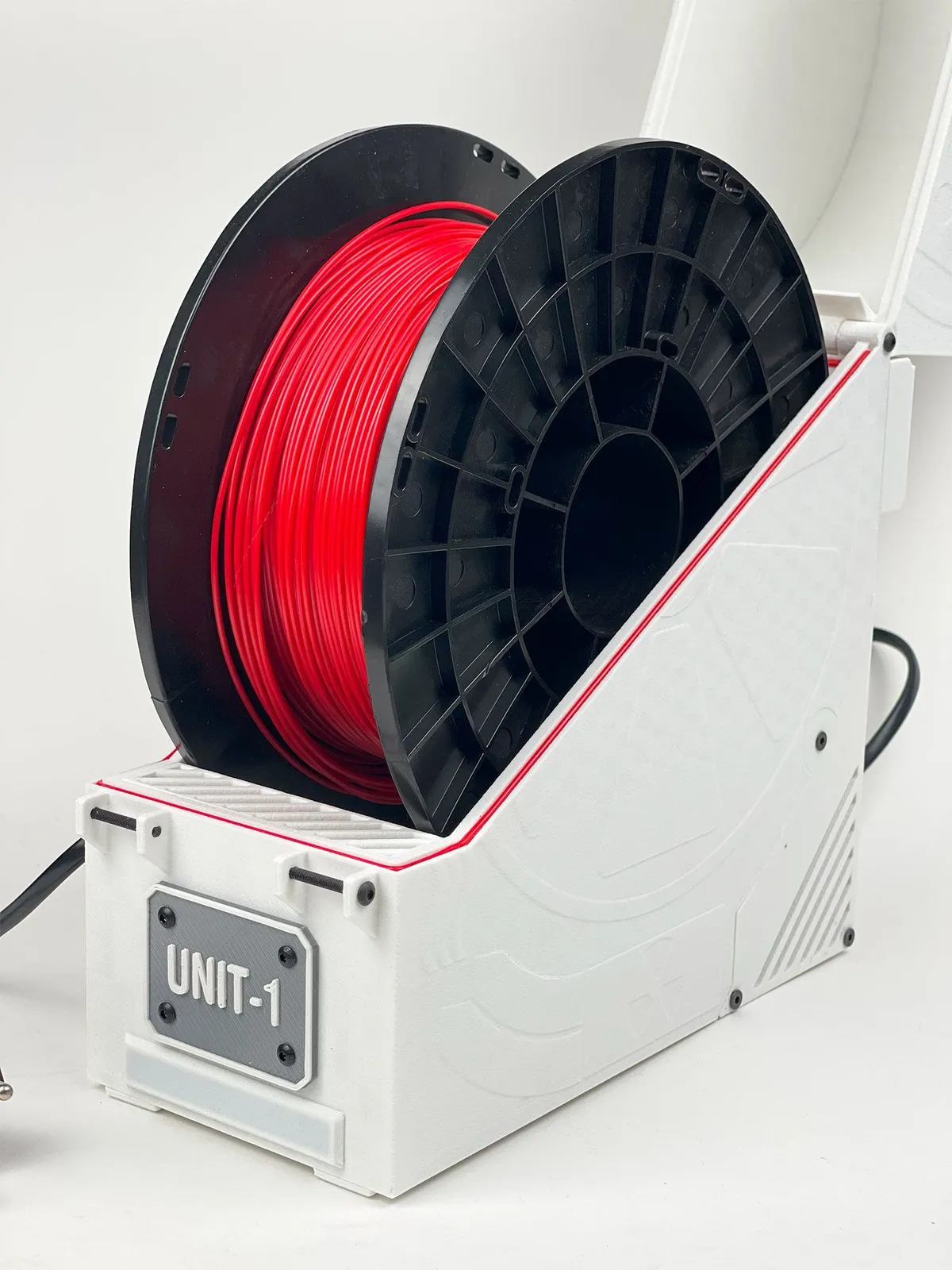
HIPS is used as a soluble support for ABS — and is equally moisture-sensitive: supports become brittle on removal and dissolve poorly in Limonene. Chamber one dries HIPS at 60 °C while the second simultaneously holds ABS at 70 °C — both materials ready at the same time. Compatible with PLA(45°C), PETG(60°C), ABS(80°C), PA(90°C), PA-CF, PC(110°C) and other materials when you need to dry different spools separately or keep filament in controlled conditions.
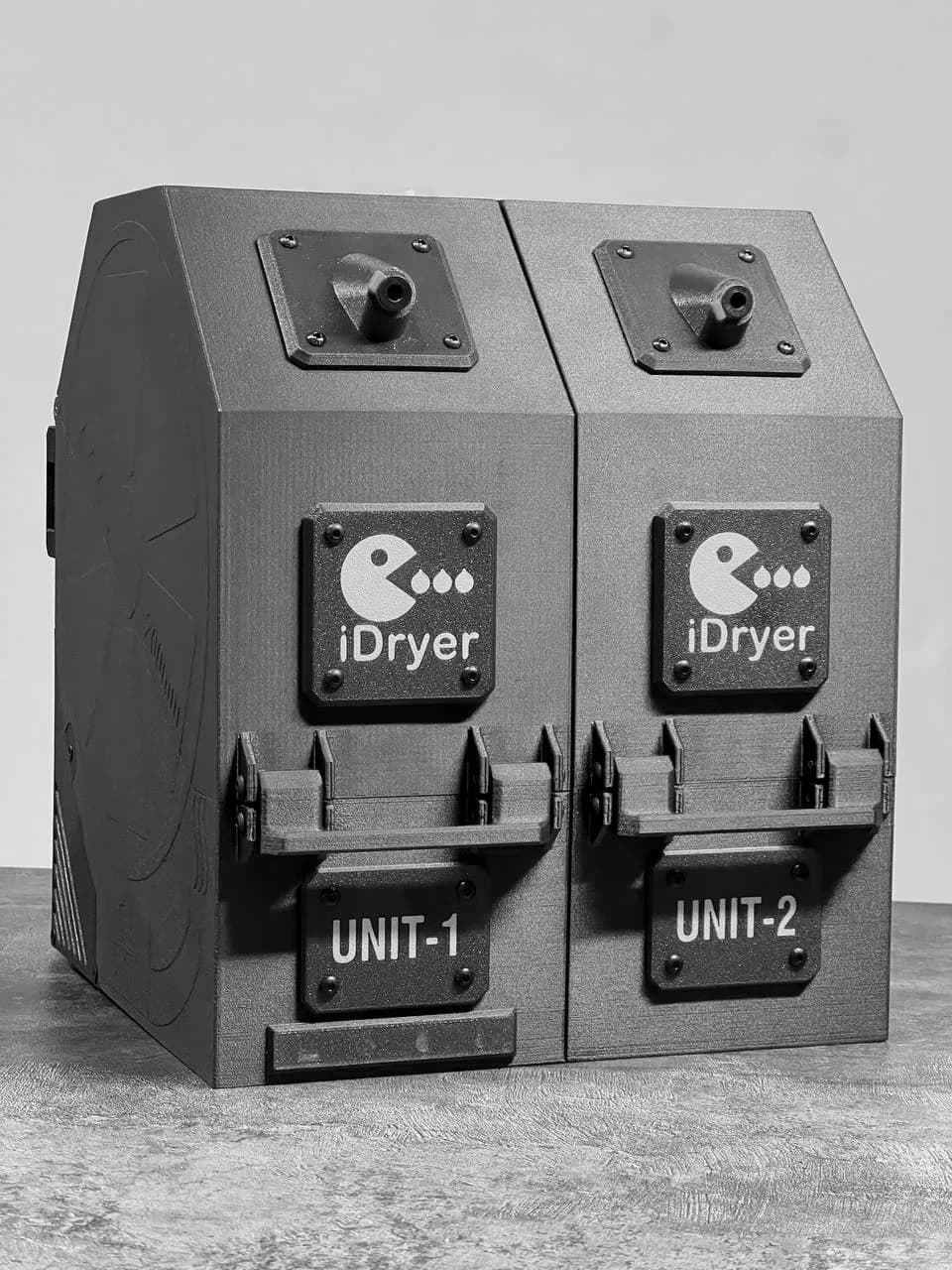
In this set — MCU and EXT at once. From day one you have a ready system with two independent chambers: each with its own temperature, humidity sensor and controlled damper. PLA at 55 °C and nylon at 90 °C — simultaneously, without queues or manual switching.

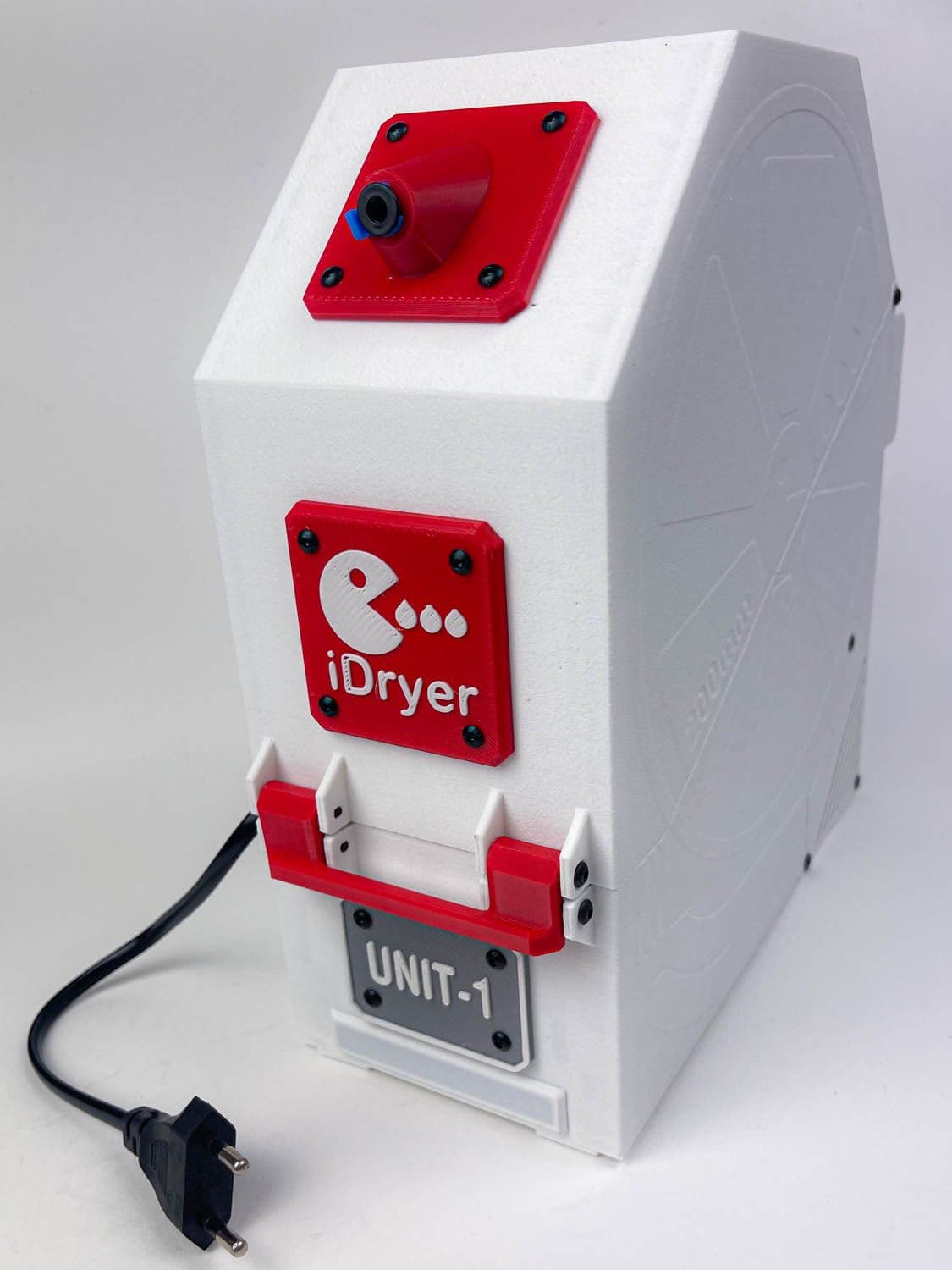
iDryer Unit MCU+EXT Kit — a bundle for assembling a complete dual-chamber filament drying and storage system. Normally iDryer Unit can be expanded gradually: first assemble the main MCU module, then add EXT. In this kit, both modules come together, so after assembly you immediately get two independent chambers. Each chamber has its own 100W heater, fan, SHT31 humidity sensor and a controlled damper for humid air extraction. The chambers work separately from each other: you can set different temperatures, modes and use them for different materials. For example, you can dry PETG in one chamber and Nylon or PC in the second. Or use one chamber for active drying and the other for storage of already prepared spools. One controller manages two modules, but each chamber remains independent. This is a convenient option if you immediately need not a single dryer, but a compact dual-chamber system for a workshop, multiple printers or different filament types.

Nylon absorbs moisture from the air in less than a day — up to 10% of its own weight. ABS and ASA absorb more slowly, but the result is the same: during printing, moisture turns into steam right in the nozzle. You hear crackling, cobwebs form between parts, layers don't hold. Ordinary dryers heat by timer without humidity control — you don't know when the plastic is actually ready. iDryer Unit measures humidity with an SHT31 sensor continuously. The damper with servo opens and actively exhausts moisture-saturated air. Temperature rises smoothly — the spool doesn't deform.
SHT31 sensor stops drying when ready — not by timer
Temperature rises gradually — no spikes, spool doesn't deform
Nylon and PC can be fed to the printer through a tube without removing the spool
Different materials — different temperatures — simultaneously, from day one

Print the housing, assemble by instructions. Electronics, heating, sensors and fasteners — everything is in the kit.

Drying — set the temperature and time. Storage — the system keeps humidity constant. At the end of the cycle, it automatically switches to storage.

The SHT31 sensor monitors humidity continuously. The damper opens and closes itself — humid air is exhausted. When the plastic is ready, the system switches to storage mode.
PLA wants 55 °C, nylon — 90 °C, PC — 110 °C. Each module maintains its own temperature independently. Started printing two materials — both dry at the right parameters. No need to choose which plastic to dry first.
One module actively dries a new PA spool. The second maintains already dried spools in Storage mode at 15–20% RH — without excessive heating. Supplies are always ready to print.
ABS, PC, PETG, nylon — each at its own temperature, each in its own chamber. One MCU controls everything. No more need to switch modes manually for each print.

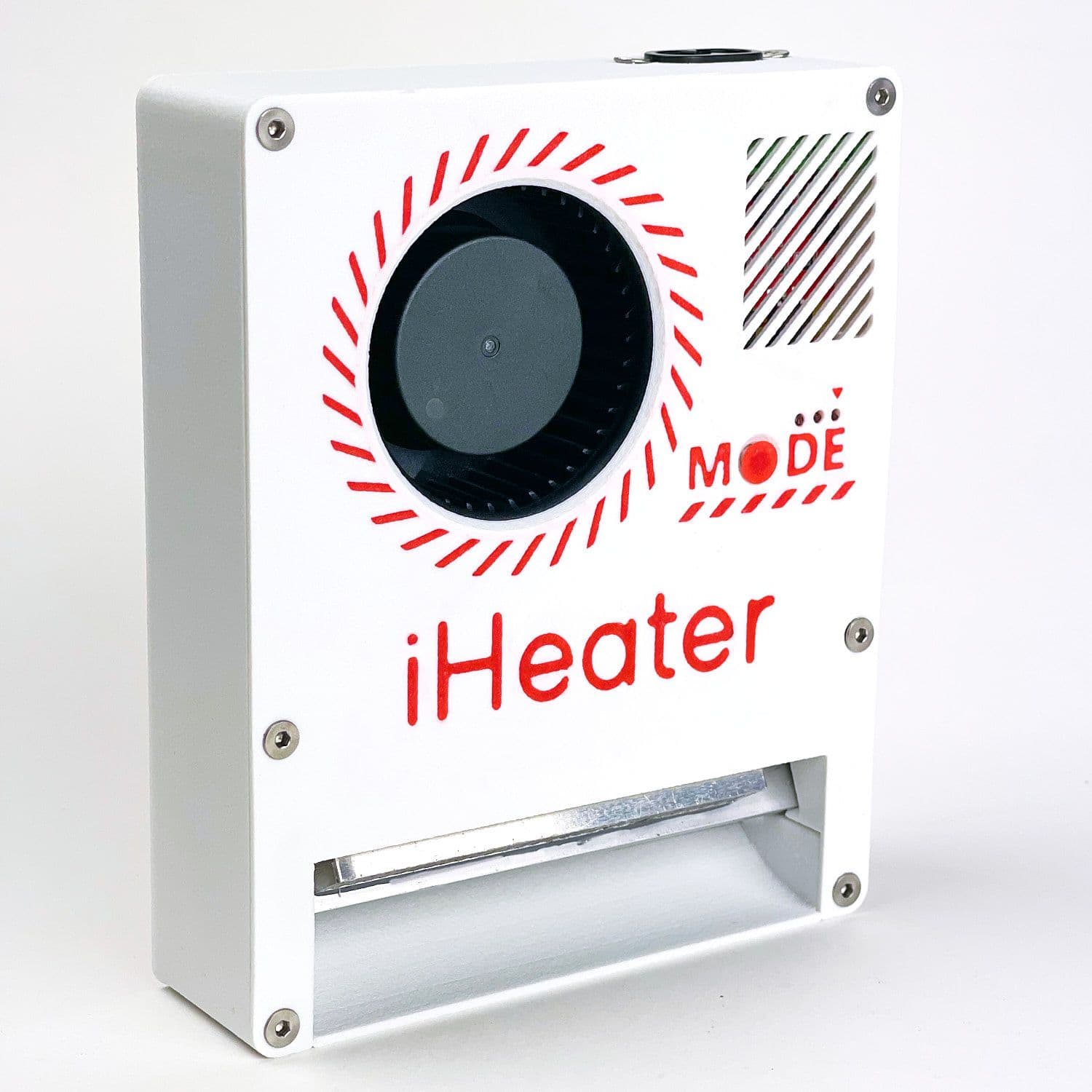
Inside the EXT module is everything that's in the main MCU block: a 100W heater, an SHT-31 humidity sensor, a controlled damper for humid air extraction, a fan. It supports both modes — Drying and Storage. The only difference: EXT has no own microcontroller — it's managed by the main block via an RJ45 patch cable. Bought MCU — one chamber. Added EXT — a second one with full functionality. In this kit, both blocks are already included.

EXT connects to MCU with a standard RJ45 patch cable — exactly the same one you use to connect your router. No proprietary cables, no special tools. MCU detects the new module on startup and adds it to the interface when powered on. Klipper sees all connected chambers as a single system when selected in the config.

Set temperature and time. At the end of the cycle, the system automatically switches to Storage — plastic doesn't over-dry.

Maintains the set humidity level constantly. Heat only turns on when needed.

Custom scenarios with adjustable transitions between modes. Available in Standalone firmware.

The controller works as [mcu] or [second_mcu] in Klipper. Control straight from Fluidd or Mainsail, G-code macros, Telegram notifications on drying status and cycle completion.

Autonomous firmware with cloud portal and mobile app control. Status and control — from your phone or browser. Optionally: OLED screen, RFID spool tracking, scales.

Assembly, connection, flashing and setup — with photos and diagrams.

Control and monitoring through portal.idryer.org and mobile app from any device.

Discord, forum, Telegram. Questions about assembly and setup get answered quickly.

The project is maintained by the author: documentation improves, updates come out and new materials appear for the community.
No. There's a full-featured Standalone firmware with control via portal and app.
Two. In the MCU Kit + EXT Kit bundle: after assembly you immediately get two independent chambers. Can be expanded with two more EXT — total four chambers on one controller.
Standard RJ45 patch cable — ordinary network cable. Not included in the kit: any short cable works.
No — you print it yourself from ABS, ABS-CF or PC. CAD models for 1 and 2 spools are available on docs.idryer.org.
Yes. Buy an EXT block and connect it with a cable. No reflashing needed. Up to three EXT modules to one MCU.
Minimal: you need to add EXT to the Klipper config. Reflashing and reinstalling the controller are not required. In Standalone, just specify the number of units in the device menu.


iDryer Unit MCU KIT — a set for self-assembly of one drying chamber. Printed housing parts are made independently: CAD models for 1 and 2 spools are available in the documentation.
Component | Quantity |
|---|---|
iDryer MCU control board | 1 |
Fan 7530 110/220V | 1 |
100W heater 110/220V | 1 |
Servo 3.7g or 9g | 1 |
KSD9700 130 °C thermal cutoff | 1 |
GY-SHT31 humidity and temperature sensor | 1 |
Thermistor 3950 100K 300 mm | 1 |
Bearing | 4 |
Shaft 90×3 | 2 |
Power cord (110/220V) | 1 |
AC005A connector (110/220V) | 1 |
Tube clip (fitting) | 1 |
Fuse RH135 15A | 1 |
LED strip WS2812 (4 diodes) | 1 |
M3×25 ISO7380 | 6 |
M3×16 ISO7380 | 4 |
M3×6 ISO7380 | 14 |
M3×10 DIN7991 | 6 |
M3×6 DIN7991 | 10 |
Component | Quantity |
|---|---|
iDryer EXT control board | 1 |
Fan 7530 110/220V | 1 |
100W heater 110/220V | 1 |
Servo 3.7g or 9g | 1 |
KSD9700 130 °C thermal cutoff | 1 |
GY-SHT31 humidity and temperature sensor | 1 |
Thermistor 3950 100K 300 mm | 1 |
Bearing | 4 |
Shaft 90×3 | 2 |
Power cord (110/220V) | 1 |
AC005A connector (110/220V) | 1 |
Tube clip (fitting) | 1 |
Fuse RH135 15A | 1 |
LED strip WS2812 (4 diodes) | 1 |
M3×25 ISO7380 | 6 |
M3×16 ISO7380 | 4 |
M3×6 ISO7380 | 14 |
M3×10 DIN7991 | 6 |
M3×6 DIN7991 | 10 |
Patch cable RJ45 for MCU↔EXT connection — not included. Any short network cable works.
Parameter | Value |
|---|---|
Chambers in the kit | 2 (MCU + EXT) |
Maximum chambers in system | 4 (MCU + up to 3 × EXT) |
Drying temperature | up to 90 °C (up to 110 °C depends on housing material) |
Modes | Drying, Storage, Profile |
Humidity sensor | SHT3X — ±2% RH, ±0.3 °C |
Heater (in each chamber) | 100W PTC, full electrical isolation |
Thermal protection | KSD9700 130 °C (in each chamber) |
Module connection | RJ45 (standard patch cable) |
Spools | up to 85 mm wide, up to 200 mm diameter |
Housing | printable, ABS / ABS-CF / PC / HTPLA |
Power | 110 / 220 V |
Control | Klipper / Standalone + portal + application |
Filament feed to printer | direct outlet via fitting (in each chamber) |
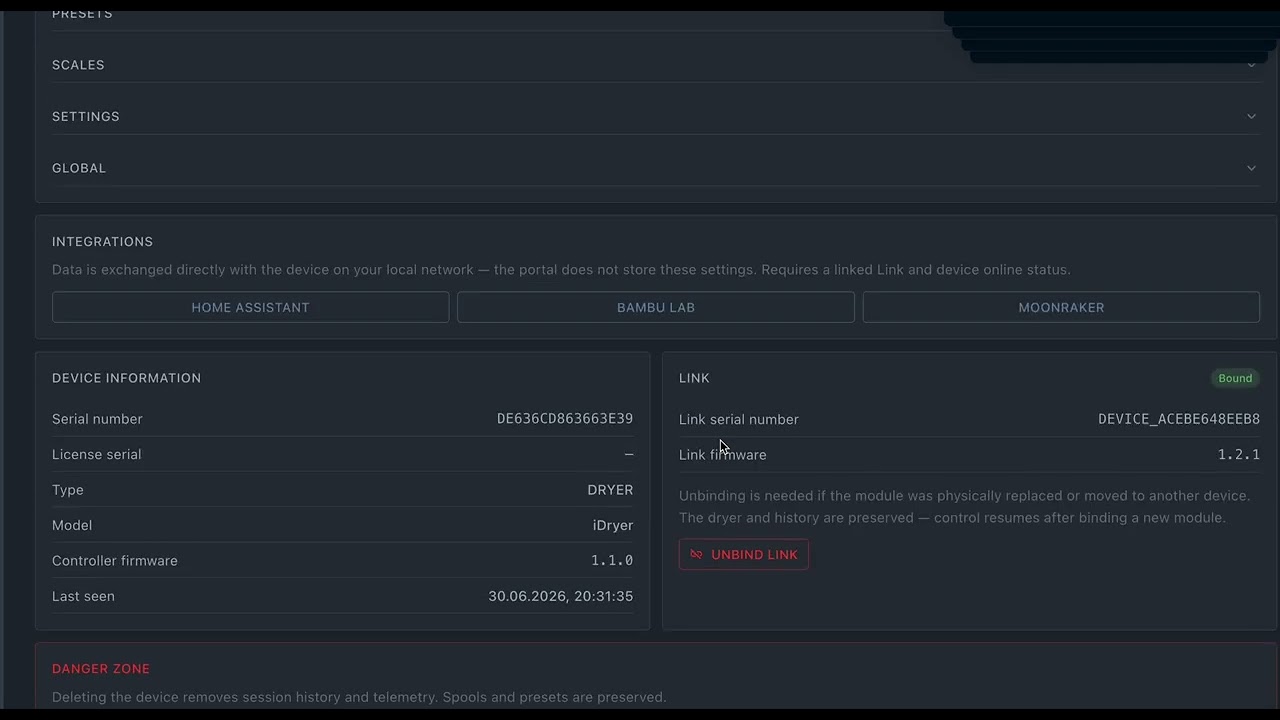
The portal shows the status of all chambers, real-time temperature and humidity, and drying cycle history. Start or stop drying from a computer, tablet, or phone. It works in any browser without installation.